Chroma Life

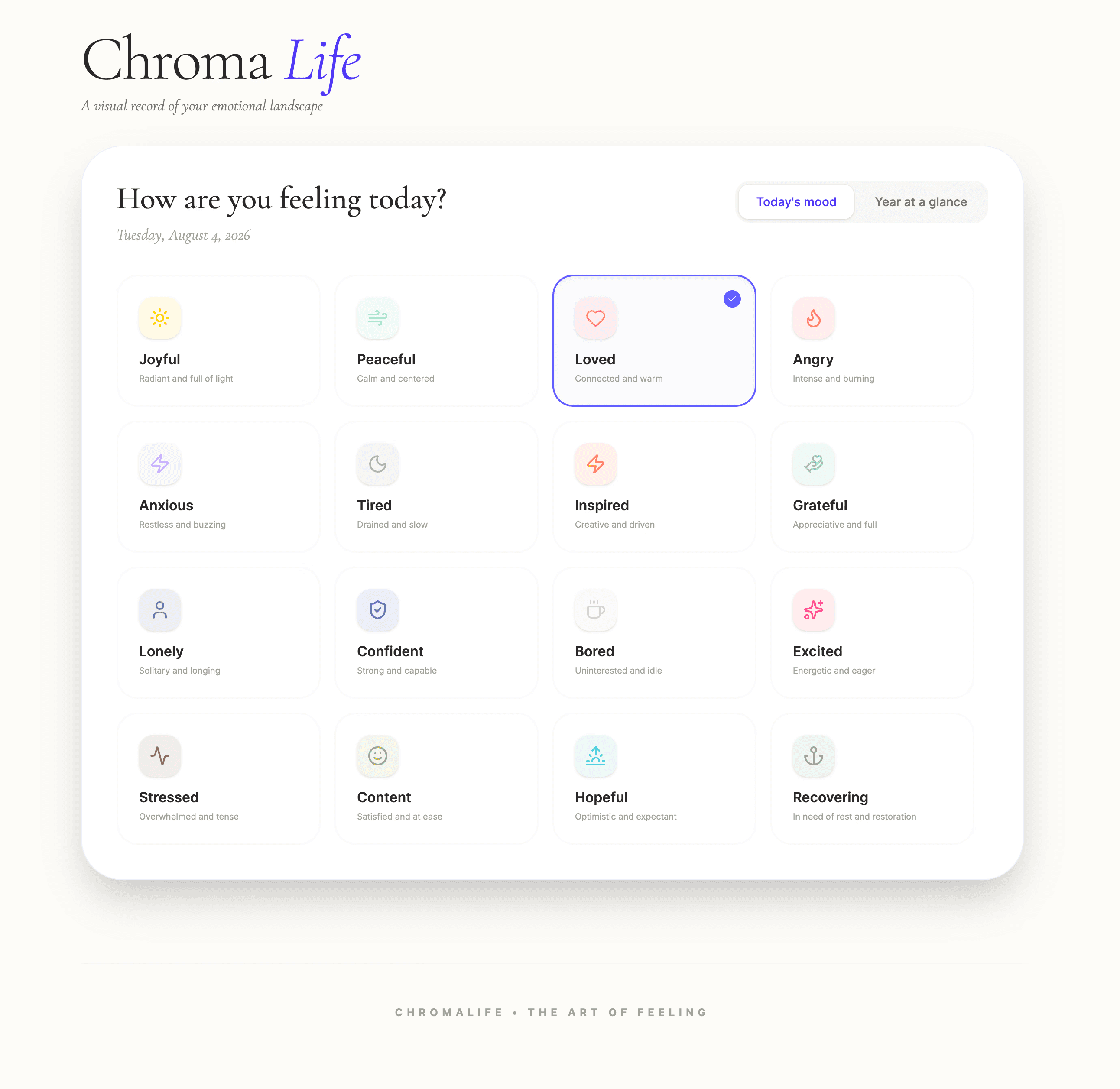
Chroma Life is a mood journal that translates each day's emotion into a colour. Log how you feel, and over a year, those colours build into a spectrum. It's a quiet, visual record of a life felt. A personal concept I designed and built with Google AI Studio.

DELIVERABLES

Web App

duration

2 Days

Role

UIUX / Developer

focus

Prototyping / Building / Deploying

background
Feelings aren’t problems to solve

Emotion is central to being human, yet it is often treated as something to manage, explain, or fix. But feeling isn’t a problem to fix. It’s a texture of being alive. I wanted to create something that felt less like a mood tracker, more like a lovable little archive of a life. 

Each day is recorded as a single colour. Over time, those colours begin to form a visual portrait of a month, a season, and eventually an entire year. Looking back, I wanted people to feel something specific: I have lived through all of these emotions, and together they made my life rich both emotionally and visually.

features
The Art of Feeling

01

Feel

02

Record

03

See

Design decision
Reflection without judgement

Many mood-tracking products are designed around identifying patterns and improving emotional wellbeing. While that can be valuable, it can also make reflection feel like another form of self-optimization. Chroma Life was designed around a different principle: emotions do not need to become goals. The product does not categorize feelings as successful or unsuccessful. It simply gives each one a place to exist.


Product
Two ways to look back

Chroma Life supports reflection at two different scales. The daily view helps you notice how you feel now. The yearly view helps you understand how much more you have felt.


The daily view creates a small moment of awareness. It asks one gentle question: how did today feel?


The yearly view creates distance. It shows that no single day or emotion defines the whole of a life.


features
The Art of Feeling

01

Feel

02

Record

03

See

Shared ownership

Compliance-driven

Risk-averse, not tech-forward

Design decision
Reflection without judgement

Many mood-tracking products are designed around identifying patterns and improving emotional wellbeing. While that can be valuable, it can also make reflection feel like another form of self-optimization. Chroma Life was designed around a different principle: emotions do not need to become goals. The product does not categorize feelings as successful or unsuccessful. It simply gives each one a place to exist.


Product
Two ways to look back

Chroma Life supports reflection at two different scales. The daily view helps you notice how you feel now. The yearly view helps you understand how much more you have felt.


The daily view creates a small moment of awareness. It asks one gentle question: how did today feel?


The yearly view creates distance. It shows that no single day or emotion defines the whole of a life.


How I built it
Building Chroma Life with AI

Chroma Life was my first independently designed and shipped AI-native product. I developed the concept, product principles, user experience, emotional system, visual identity, and interface as one connected process. AI made the implementation process faster, but maintaining a coherent product still required consistent human judgement. Every feature had to support the same central idea: reflection without pressure.

What I Learned

Building a small product showed me that simplicity does not come from having fewer ideas. It comes from making clear decisions about which ideas belong. The most important design decisions in Chroma Life were often decisions not to add something: no streak, no emotional score, no productivity language, and no demand for a detailed explanation.

Working with AI-native tools also changed how I thought about prototyping. Once a design becomes functional, small assumptions that remain invisible in a static screen become much easier to recognize. Chroma Life began as an experiment in emotional reflection, but it also became an experiment in how one designer can take a product from an early idea to a complete, working experience.

What I Learned

Building a small product showed me that simplicity does not come from having fewer ideas. It comes from making clear decisions about which ideas belong. The most important design decisions in Chroma Life were often decisions not to add something: no streak, no emotional score, no productivity language, and no demand for a detailed explanation.

Working with AI-native tools also changed how I thought about prototyping. Once a design becomes functional, small assumptions that remain invisible in a static screen become much easier to recognize. Chroma Life began as an experiment in emotional reflection, but it also became an experiment in how one designer can take a product from an early idea to a complete, working experience.

How I built it
Building Chroma Life with AI

Chroma Life was my first independently designed and shipped AI-native product. I developed the concept, product principles, user experience, emotional system, visual identity, and interface as one connected process. AI made the implementation process faster, but maintaining a coherent product still required consistent human judgement. Every feature had to support the same central idea: reflection without pressure.